
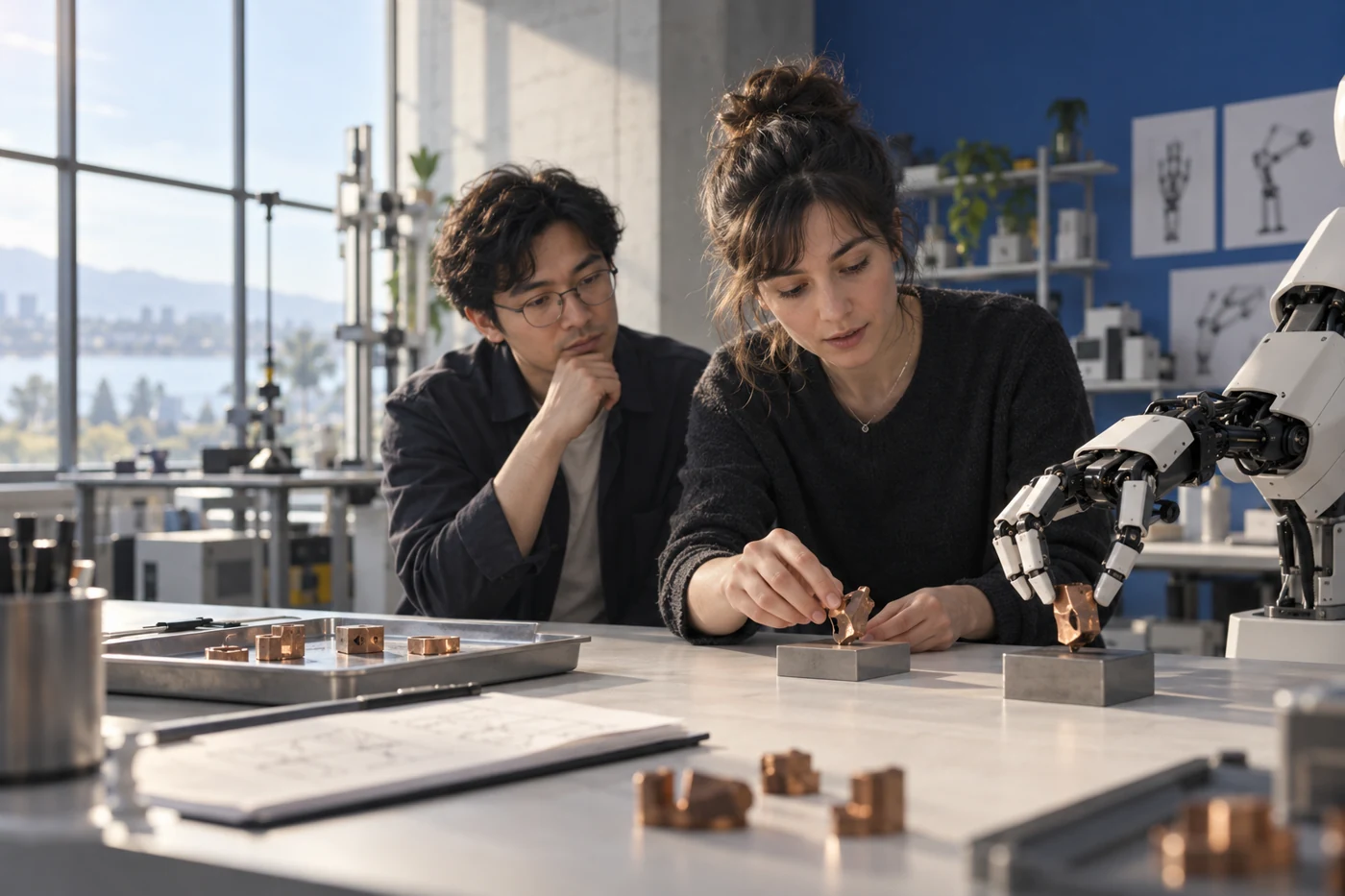
Ask someone to pick up a glass and you need not specify the angle of their hand. They see the object, adjust their grip and correct the movement along the way. For a robot, that short request requires a chain of connections between perception and action.
This explains why everyday movements are subjects of university research. Robot learning does not mean reproducing human understanding or muscle memory. Researchers develop methods that generate appropriate actions from sensor information, then test and compare them on particular tasks within defined limits.
Three questions help navigate the field. What does the robot learn from? How does it generate successful behaviour? What happens in a situation it has never encountered? Learning experiments, European test environments and data collected across continents address different parts of these questions.
Lesson one: learn from a demonstration
One approach collects examples of people performing tasks. When a researcher remotely controls a robot, the camera observations and the robot's movements can be recorded together. A learning system uses these examples to learn actions for similar observations. This is imitation learning. [1]
The 2024 Mobile ALOHA project by Stanford researchers explored this approach with a mobile base and two robot arms. Human-controlled demonstrations supported work on tasks combining movement with object manipulation. Demonstrated activities included putting a pot in a cabinet, calling and entering a lift, and lightly rinsing a used pan. The project page separates autonomous capabilities from teleoperated demonstrations. [2]
That distinction matters whenever we watch a robot video. Real-time human control can be valuable for collecting learning data or testing hardware. It does not show the robot performing independently. Evaluating a result requires knowing how the movement was produced.
For businesses, this opens a path to recording expertise more systematically. What makes an example useful? How is task success defined? How are unusual situations handled? Experienced employees are an important source of knowledge for defining the work that a robot should learn.
Lesson two: more than one way to move
We might reach for a glass from the right or the left. A successful task can have several movement paths. Representing that variety helps a learning method generate suitable behaviour.
Diffusion Policy uses diffusion models to produce robot behaviour. Conditioned on the observed scene, it progressively generates an action sequence and updates its plan as new observations arrive. In this context, a policy is a learned rule connecting observations to actions. The work includes real-robot experiments as well as simulation. [3]
In everyday terms, the system calculates a short sequence of movements rather than committing to one motor command at the start. It can revise what comes next as it receives new information. This describes a computational relationship between observation and action, not human-like thought. [3]
Performance in a research test and the ability to provide a service all day require separate assessments. Speed, hardware limits, unexpected contact and events beyond the intended task need further examination in real use. Academic success can provide a strong starting point.
Lesson three: do it in another room
In robotics, generalisation includes whether a movement learned in a laboratory works in a different kitchen. Worktop height, camera angle, lighting and object shape can change. Differences that seem minor to a person can expose the limits of learned behaviour.
Introduced in 2024, DROID is a collaborative research dataset intended to increase the diversity of training examples. The project includes about 76,000 robot demonstrations across 564 scenes and 86 tasks, collected in North America, Asia and Europe. The team reports improved robustness to scene changes and task performance in its own experiments. Data, training code and a hardware setup guide are shared. [4]
These figures do not mean robots can work everywhere. They illustrate the role of diverse data in research. Our practical question is how closely a system's training world resembles the place where it will work. One value of a pilot is making that distance visible.
Businesses may contribute to future research through more than purchasing equipment. Task examples with clear permissions and conditions of use, test scenarios and failure records can also help. Collaboration should address collection costs, employees' roles and what information may be shared from the start.
Europe's contribution: bring the test closer to reality
Another route to robot learning improves behaviour through feedback on results. In reinforcement learning, the system seeks to improve relative to a defined objective. Simulation offers a place to try different conditions, but transferring learned behaviour to a physical robot requires testing. ETH Zurich's Robot Learning course addresses imitation and reinforcement learning alongside simulation and real-robot applications. [1]
Launched in Germany in 2024, Robotics Institute Germany connects universities and non-university research institutions. Its founding announcement describes a network led by the Technical University of Munich that combines research, infrastructure, education and technology transfer. DFKI's contributions include test environments in Bremen and production-research infrastructure in Kaiserslautern. [5]
Such a network allows connected problems to be tested together. An algorithm's performance, a sensor's information and a machine's physical behaviour are interdependent. Taking research into a business adds maintenance arrangements, user training and links to existing processes. A practical expression of scientific method is turning these connections into measurable trials.
The examination beyond the laboratory
The next time a robot makes the news, consider three questions. Which task was actually demonstrated? How was human support used? Under which changing conditions and within what limits was success measured? These questions help us understand the innovation more clearly.
Universities are teaching capabilities close to daily life: reaching, placing, finding a route and reassessing a situation. Much of the research ahead will concern connecting these capabilities and using them reliably in different environments. Its pace and reach cannot yet be reduced to a single timetable.
A robot knowing where to begin when asked to help would be significant progress. Equally valuable is making clear what it can do when conditions change, and where it needs assistance. The road from the laboratory to our lives passes through the details of ordinary work.
Sources & further reading
A publication of GappAI GmbH. Analysis, publisher perspectives and conceptual AI illustrations are identified as such.
Editorial team & standards · Report an errorContinue the conversation with GappAI.
Discuss your operation ↗