
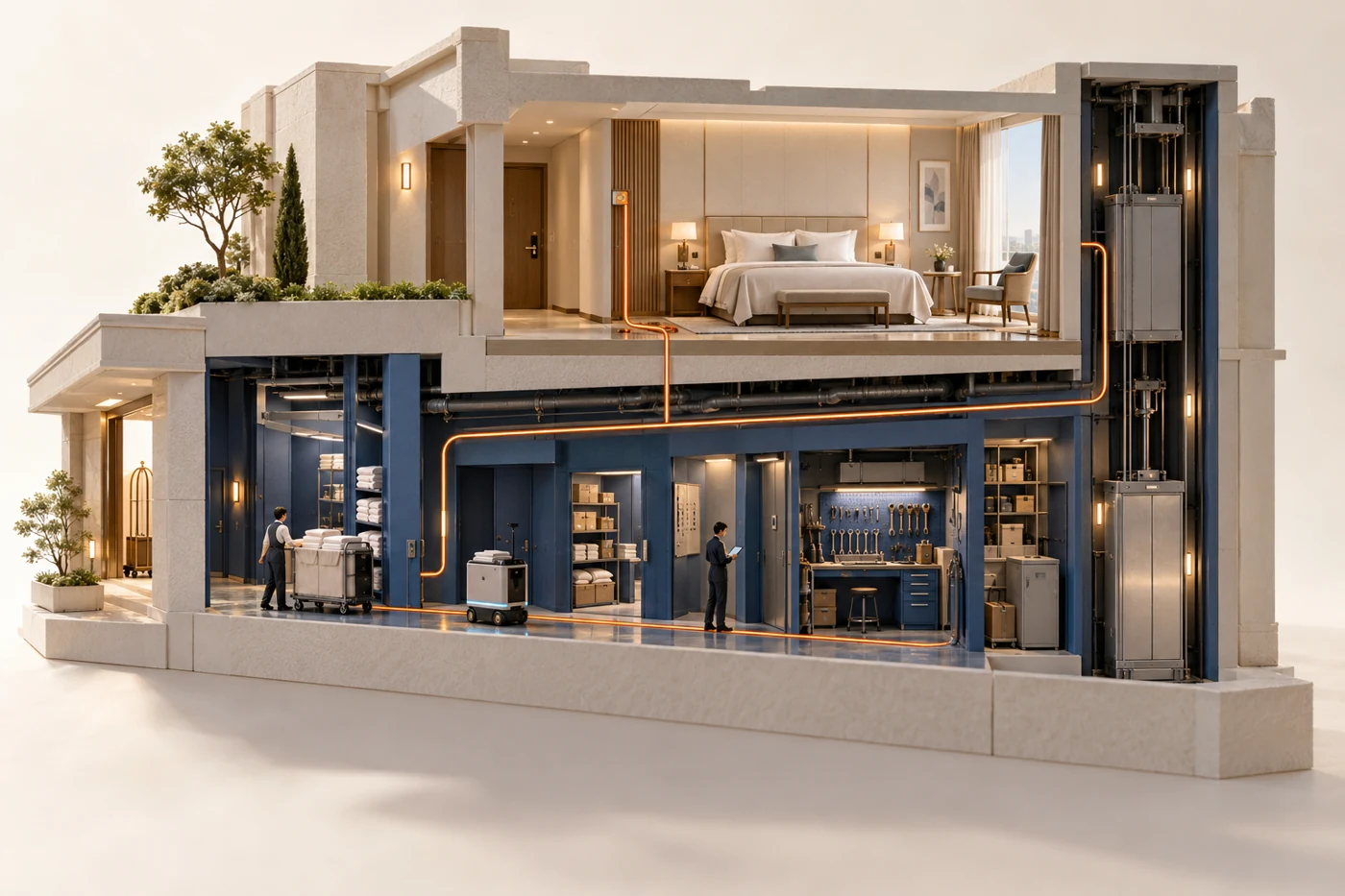
You enter a hotel room and put down your suitcase. The towels are in place, the lights work, the room is ready. Someone else may have been staying there only hours earlier. The work completed and decisions made before your arrival are invisible. Good service has a curious quality: as the effort behind it grows, the effort a guest feels can diminish.
Here we look at a hotel through its connected processes. The room and delivery examples are illustrative, rather than observations from a particular property. To understand what technology might contribute, we need to examine the connections that usually remain out of sight.
When is a room really ready?
Cleaning a room, resolving a maintenance problem and releasing it to the next guest are connected but distinct activities. Cleaning may be complete while a technician has yet to assess a fault. Reception may be looking at information that is already a few minutes old. In that situation, a delay can reflect the way information travels as much as the speed at which people work.
Hotel management software gives these distinctions a technical form. Oracle's OPERA Cloud documentation treats housekeeping status as a separate piece of information that changes during a stay. “Clean” identifies a cleaned room; the optional “Inspected” status records that a supervisor has checked it. Cleaning and inspection can therefore be tracked as separate stages. [1]
The operational lesson is simple: establish who changes a status, when they change it and what conditions must first be met. If “completed” means different things to different teams, automation inherits that ambiguity. Agree on the vocabulary before automating the handover: clean, inspected, awaiting maintenance, delivered.
A hotel has two circulation systems
Materials continually move through a hotel: clean and used linen, food, maintenance equipment and waste. At the same time, a second circulation system carries room status, guest requests, stock information, fault reports and work orders. Where physical movement and information fail to meet, employees bridge the gap with phone calls and conversations in corridors.
Imagine extra towels being delivered to a floor. If the delivery happens but the record is not updated, another team may set off unnecessarily. If the request is marked complete but the towels were left in the wrong place, the guest still waits. Both examples show why movement and information need to be verified together.
A physical robot might be suitable for the transport task. A digital system might put the request into the right queue or communicate its status. Connecting them requires a task identifier, delivery point, permissions and a clear completion condition. Preventing the same request from being processed twice is part of the design. A useful connection makes the outcome of a message visible as well as sending it.
Peak hours have their own logic
Total daily workload does not, by itself, describe the pressure a hotel experiences. Many departures, early arrivals and preparations for an event can converge in the same time window. A system that works comfortably during a quiet hour may create queues under those conditions. Evaluation must therefore consider how work is distributed across the day.
A transport solution that occupies a service lift for too long may accelerate its own task while delaying another team. Software that starts more jobs can multiply notifications without increasing the capacity to fulfil them. Local gains in speed need to be measured alongside service quality across the hotel.
The first step need not involve placing sensors or robots everywhere. Understanding the time between a request, the start of work and a verified result in one selected flow may reveal the bottleneck. The appropriate intervention can then be discussed: task allocation, software integration, stock location or physical automation.
How early does a problem become visible?
Spotting a problem before a guest reports it can create more time to respond. But opening a fault report and resolving the fault are different things. Someone must receive the report, set its priority and authorise the room's return to use.
In a future system, building data could be linked to work orders. The benefit would lie in verified interventions completed on time, rather than in the number of alerts generated. Unnecessary warnings consume attention and can bury significant signals. Attention, too, is a resource that hotel management needs to plan.
The European Agency for Safety and Health at Work, EU-OSHA, examines opportunities for digitalisation and advanced automation to improve work alongside their organisational and psychosocial effects. That is a strong reason to put employees' experience of their working day at the centre of system design. [2]
Technology the guest need never see
Guests prefer different ways to obtain service. One wants to send a request from a phone; another wants to speak to someone at reception. If the operation behind those channels connects them to the same chain of responsibility, technology can make service easier to understand. A guest need not learn which systems their request passes through.
The same principle applies to data. The information needed for a delivery is different from a guest's entire profile. Decide during implementation which system needs access to which information, and why. Collecting more data does not invariably produce better service.
A city hotel in Berlin and a resort on another continent do not run identical operations. Their buildings, service expectations, working practices and software differ. A common approach is to make those differences visible and build around the actual flow of work. We will not recognise tomorrow's good hotel solely by the devices in its lobby. Sometimes its clearest innovation will be something we expected happening exactly on time.
Sources & further reading
A publication of GappAI GmbH. Analysis, publisher perspectives and conceptual AI illustrations are identified as such.
Editorial team & standards · Report an errorContinue the conversation with GappAI.
Discuss your operation ↗