How does human knowledge become a skill?
Explore AI, data and software through a concrete learning task.

Children and young people in Germany should have the opportunity to understand the technology shaping their future — and imagine what they could create with it.
GappAI Discovery brings schools, university volunteers and sponsors together around one question: how do we teach a robot a skill? Human expertise, software and responsible engineering make the world of tomorrow tangible.
Support a Discovery DayGappAI Discovery is planned to launch in 2027, subject to the necessary conditions being met and applications being suitable for the programme. During preparations, we invite schools, university students, sponsors and public bodies to register their interest.
Planned launch · Programme in development
How do you teach a robot a skill?
01 / Our purpose
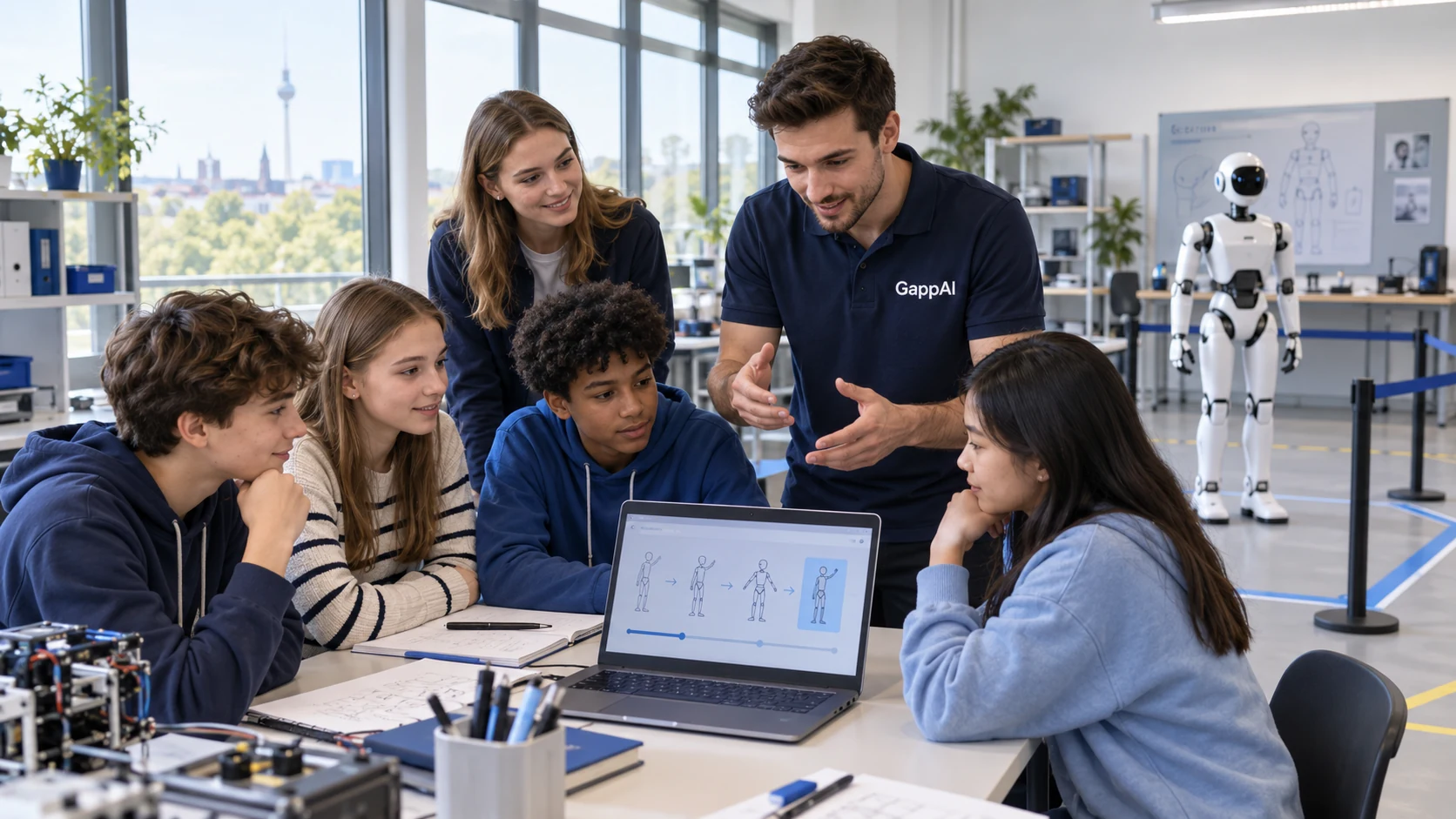
Germany’s future capacity to innovate also depends on the opportunities young people have to explore technology. As a technology company based in Berlin, GappAI wants to contribute its engineering expertise to that shared educational task.
The programme is intended for children and young people in Germany, whatever their background. By exploring how people demonstrate, test and improve a robot skill, learners can discover the role of software and the people behind it. Our aim is to encourage curiosity, critical questions and confidence to pursue their own ideas.
The programme plans to demonstrate skills developed and validated by GappAI on a robot platform owned by GappAI. Students will explore how human knowledge is translated, through software and training, into a task a robot can perform.
The engineering behind Discovery ↗Explore AI, data and software through a concrete learning task.
Recognise errors, discuss limits and understand responsibility.
Develop ideas for everyday life, work and living together.
02 / How a skill takes shape
An example: move an object to a marked place. Children examine the steps and decide what successful completion means.
What is the object? Where should it go? What must remain untouched?
Identify the information, instructions or demonstrations the system would need.
Did it reach the right place? What failed, and when should a person intervene?
Refine the example or instruction, then compare the result.
Illustrative learning exercise. A classroom sequence is not itself machine-learning training. Physical demonstrations use only validated capabilities; other steps are explored with materials or simulation. No instant autonomous learning is promised. Demonstrations distinguish manufacturer-provided functions from skills developed by GappAI.
03 / Discovery Day
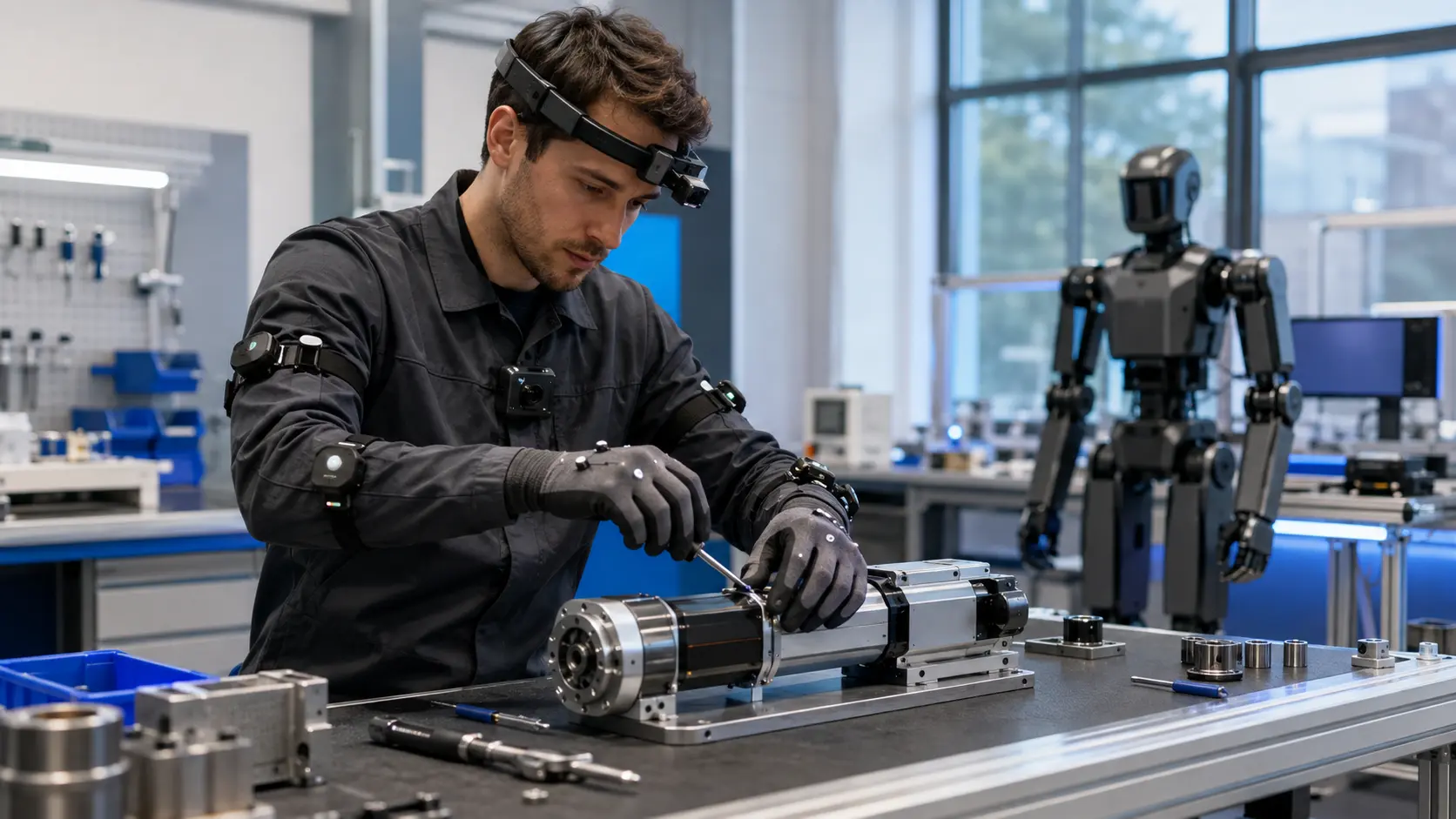
A proposed 60-minute session, adapted with the school to the age group, learning needs and venue. Robot movement is one part of the session.
Why engineering? What would you teach a robot?
Turn an everyday action into steps and a clear goal.
A controlled demonstration of a confirmed capability.
Small-group sequencing, feedback or problem-solving activity.
Questions, careers and a short reflection.
Explain the prepared material, support activities and answer questions after orientation.
Set up, control and supervise the robot and its technical operating boundaries.
Provide pupil supervision and educational responsibility throughout.
Starting team model, adjusted to group size and the assessed setting. Preparation, transport, setup and pack-down are additional to the one-hour session.
04 / University volunteers
University volunteers connect younger learners with the people behind engineering. They gain communication and teamwork experience while exploring how robot skills are developed.
Programme orientation, age-appropriate explanations and safety briefing.
An introduction to the robot's software and learning workflow. Supervised interaction where suitable and authorised.
Support a school session with an operator and the school's teacher.
A verified contribution record; a thank-you plaque may recognise sustained or notable participation.
Volunteering is confined to Discovery. It does not substitute for paid commercial event staff. Participation does not automatically confer robot-operation authority, technical certification, academic credit, an internship or employment. Roles, supervision and insurance are agreed before participation.
Volunteer as a student05 / Funding & cooperation
Sponsors cover the agreed education-event costs. GappAI adds no profit markup, and participating schools and students pay no participation fee.
The budget can include content preparation, coordination, actual staff time, transport, materials, relevant insurance, orientation, recognition items and a reasonable robot-use and maintenance share. Reusable preparation is allocated fairly; the same expense is never charged twice.
Unused budget is refunded or carried forward only as agreed with the sponsor. Additional cost requires prior agreement. GappAI does not promise donation receipts or charitable tax benefits.
06 / Responsibility
Discovery days use suitable capacity after engineering commitments and maintenance have been planned. A school date is confirmed only when funding, staffing and readiness are secured. A confirmed visit is not displaced by a later commercial booking.
Sessions use manufacturer instructions, a venue assessment and an operator-led plan. Teachers or responsible adults supervise pupils. A controlled demonstration area separates children from moving joints. Touch, hugging and climbing are not encouraged.
School enquiries use adult contacts and approximate group numbers, not pupil lists. Sensor operation, recording and cloud transfer are assessed separately for each session. Children's images and speech are not used for model training by default. Photography and video permissions are separate and are not a condition of attendance.
We plan to document delivered sessions, participating schools, aggregate attendance, verified volunteer contributions and teacher feedback. Short, age-appropriate activities assess understanding. Only real, permissioned results will be published; a one-hour session is not presented as proof of long-term career or neurological outcomes.
07 / Take part
Three ways to take part. Each starts with a short request and a separate suitability review.
Make an education day possible or propose an educational partnership. Funding and collaboration are agreed according to your actual role.
Register your school's interest. A visit is confirmed only after funding, venue review and scheduling.
For students aged 18 or over with an interest in engineering, computing or related fields. Suitability, preparation and participation are discussed individually.