

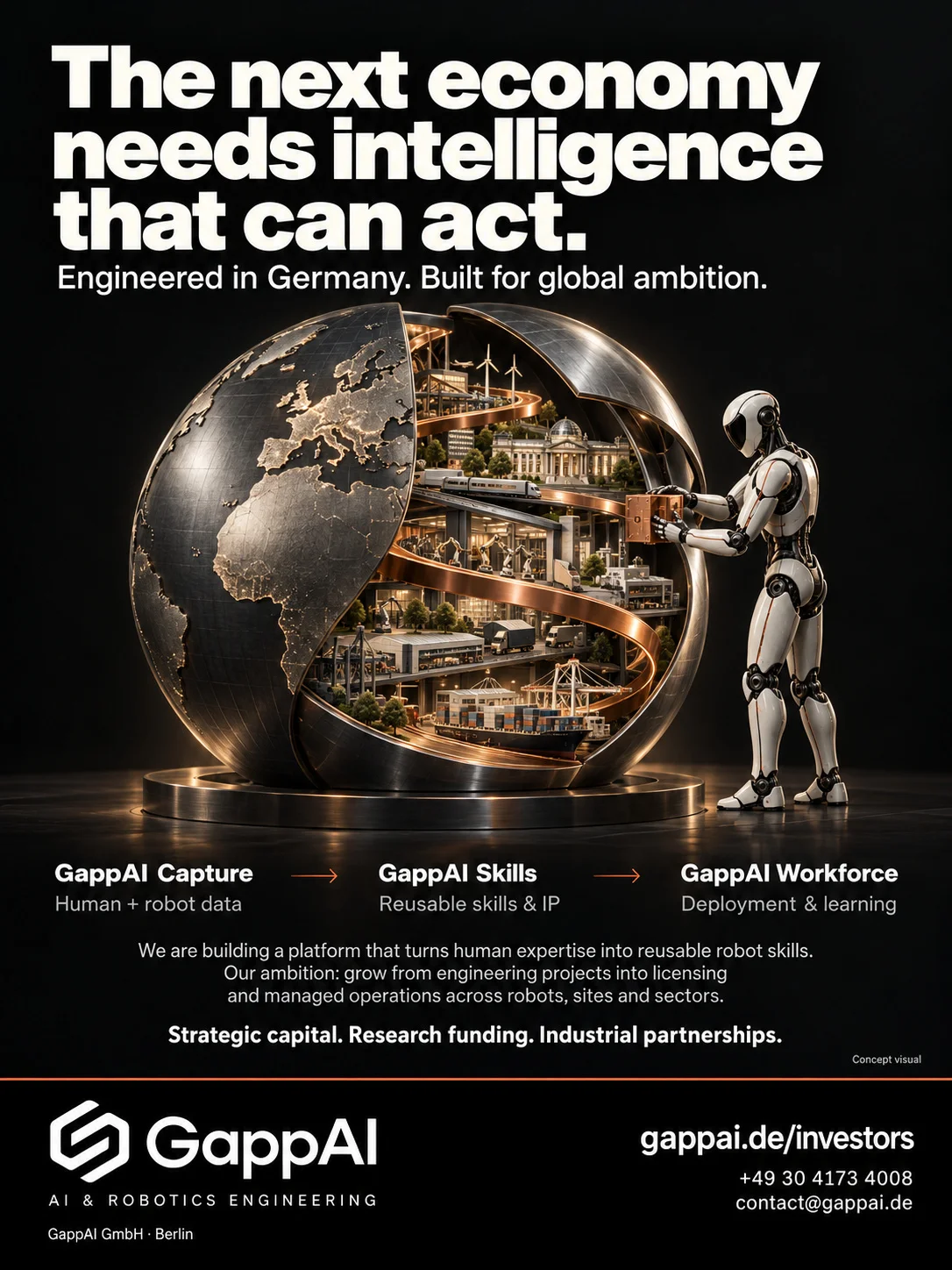
Human expertise becomes reusable robot skill.
Data methods, validated capabilities, software and evaluation systems compound inside GappAI.

Investment Case / Institutional Scale
The platform at a glance
GappAI is designed to concentrate the intelligence, operating system and customer relationship while using the right capital structure for each stage of deployment.
Data methods, validated capabilities, software and evaluation systems compound inside GappAI.
GappAI can train customer fleets or coordinate a complete managed robotic service.
Dedicated vehicles may connect suitable contracts with banks, lessors and infrastructure investors.
The physical economy remains largely unlearned.
AI has transformed digital work, while much of the world's valuable physical work still depends on human perception, dexterity and judgment. Robot hardware is advancing, but useful deployment remains constrained by task data, adaptable skills, safety and the cost of integration.
GappAI's long-term opportunity is to build the learning and deployment layer between human expertise and robotic autonomy—beginning with measurable operations and expanding toward increasingly general physical intelligence.

Each deployment is intended to strengthen reusable technology, evaluation methods and operational knowledge. The objective is a company whose value compounds across robots, sites and sectors.
Methods for translating expert perception, decisions and motion into machine-readable demonstrations.
Versioned, evidence-bound capabilities designed for licensing and adaptation across supported robots and environments.
Permissioned, purpose-bound experience from real tasks and environments, handled under defined agreements.
Repeatable measures for safety, reliability, cycle time, intervention rate and field performance.
Integration patterns connecting models, sensors, robots and customer operations.
Engineering, regulatory and operating discipline accumulated across Physical AI programs.
A paid pilot can create a new capability. Once evidence supports a defined maturity level, the reusable core may enter the GappAI Skill Library and support further licensed deployments.
New operations begin with paid analysis, skill engineering and bounded validation.
Eligible learning is packaged with evidence, interfaces, safety boundaries and version history.
Each robot, tool and operating environment receives scoped integration, calibration and validation.
Licensing, updates, monitoring and support can increase recurring revenue as a core skill reaches further deployments.
Margin potential can improve as the same core engineering supports multiple customers. Each deployment remains evidence-bound and subject to its own safety and performance assessment.
Explore the Skill LibraryEarly revenue is expected to be engineering-led. Over time, reusable skills, software and fleet-level deployment can increase the share of recurring and scalable revenue.
Paid technical assessment of the workflow, value, constraints, hardware and data requirements.
Paid skill engineering, sensing, prototyping, validation and controlled field deployment.
Implementation across robots, facilities, shifts and connected operational systems.
Licensing of validated capabilities by robot, site, workflow or agreed usage scope.
Recurring software for monitoring, model updates, evaluation and fleet-level improvement.
Ongoing performance engineering, new-condition adaptation and technical support.
Joint development and technology licensing with robot manufacturers and integrators.
Long-term skill packages and autonomy services for the built environment and everyday life.

Our market sequence is designed to generate operational proof in structured environments before moving toward more dynamic, human-centered spaces.
Manufacturing, logistics, inspection, maintenance and repetitive skilled operations.
Municipal services, infrastructure, transport systems and essential city operations.
Property operations, hospitality, campuses and environments shared with people.
General-purpose physical intelligence supporting everyday tasks and independent living.
GappAI's long-term architecture separates the high-value intelligence and operating layer from the capital required to own robot fleets.
Skill systems, software, deployment methods, customer relationships, performance data and fleet management remain concentrated in GappAI.
Where validated performance and suitable contracts exist, project vehicles may hold robot assets with financing from lessors, banks, strategic capital or infrastructure investors.
Milestone-led allocation
GappAI intends to allocate capital against defined technical and commercial milestones—not against spectacle. Priority areas include core research, engineering talent, skill-data infrastructure, safety and validation, field pilots, intellectual property and European deployment capacity.
Financing approach
We evaluate strategic equity, venture and growth capital, non-dilutive European funding, project financing and suitable asset or debt financing according to the maturity, risk profile and capital requirements of each program.
Our long-term objective is to build a company capable of meeting the operating, reporting and governance standards expected by institutional—and, when appropriate, public—capital markets.
Convert qualified operations into bounded, evidence-producing engagements.
Turn project learning into transferable skills, methods and deployment assets.
Demonstrate capabilities across supported robots, sensors and operating conditions.
Grow licensing, software, support and continuous-improvement relationships.
Build institutional, industrial, public-sector and research partnerships across Europe.
Develop reporting, controls and decision structures appropriate to company maturity.
Our operating model is designed around milestone-based budgeting, project-level performance tracking, documented decisions, clear handling of customer information, intellectual-property discipline and progressive internal controls.
Physical AI remains an early and capital-intensive field. Material risks include technical reliability, hardware dependencies, long enterprise sales cycles, regulation, data rights and the transition from pilots to scaled deployments.
Confidential information package
Detailed corporate, financial and technical materials may be made available to qualified institutional and strategic parties following an initial review and, where appropriate, a confidentiality agreement.
Institutional, financing and strategic capital inquiries