GappAI Skills is the intelligence and IP core of the platform—turning governed human and robot data into training-ready datasets, policies, evaluations and reusable professional robot skills.
Most robotics projects begin again from zero. The GappAI Skill Library is our long-term product direction for converting project-specific engineering into reusable Physical AI assets.
It is not presented as a catalogue of off-the-shelf products available today. Skills enter the library only as evidence, supported hardware and operating boundaries become clear.
02 / Proprietary system architecture
Structure the work.
Reuse the intelligence.
Three connected technology assets form GappAI’s intended IP core. They connect human expertise to configuration-bound robot capability — without making one manufacturer the center of the system.
GappAI / Work-to-skill architectureArchitecture specification / In development
Input · GappAI Capture
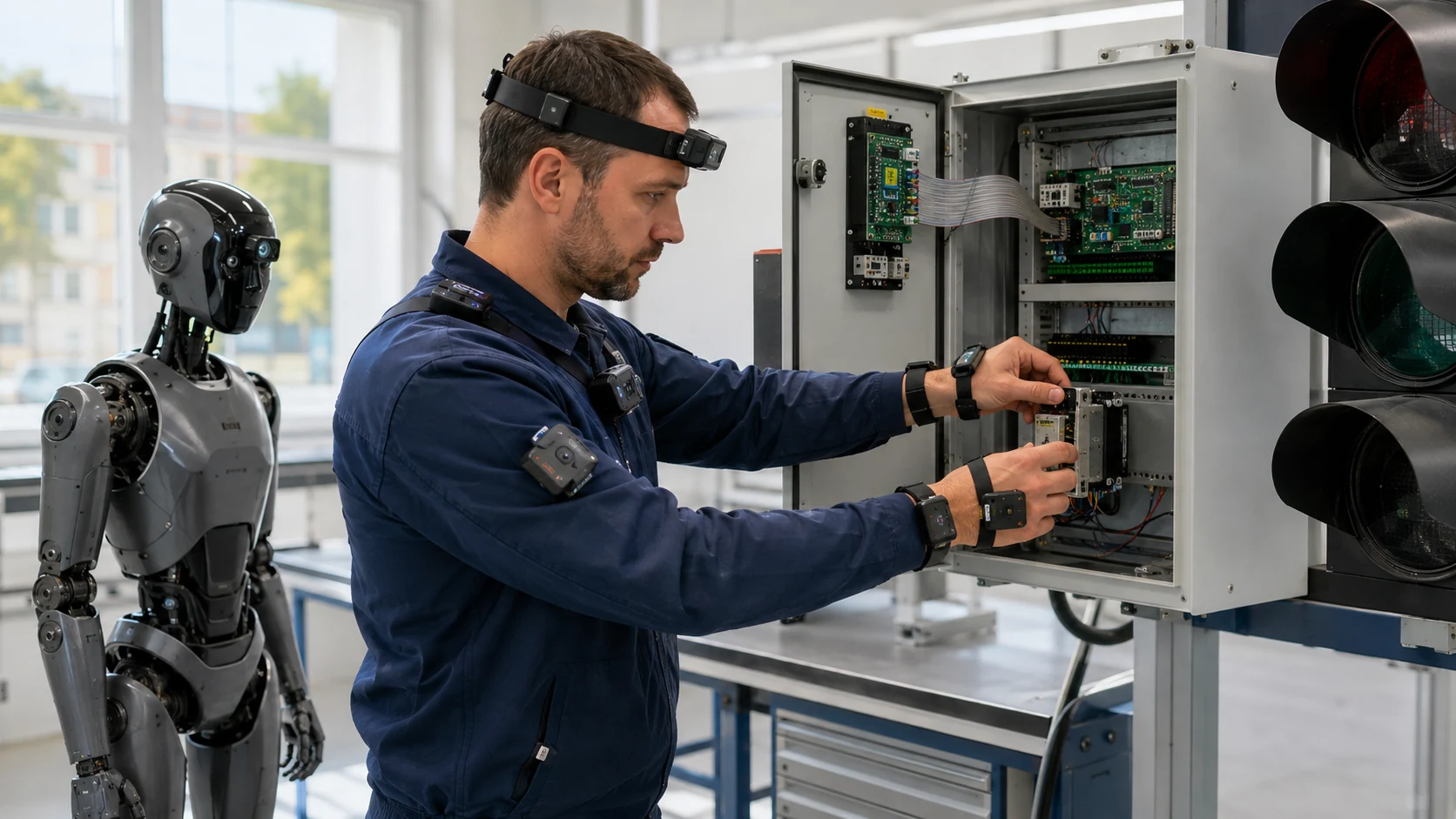
Passive expert capture
Instrumented demonstrations
Teleoperation & corrections
Robot operational data
01 / Work representation
Work Graph
From observation to a structured task.
Connects tasks, subtasks, objects, tools, decisions, movements and contacts with success criteria, failures and recovery paths.
Tasks & dependencies
Objects, tools & contact
Decision → success / recovery
Output: an inspectable work model and a foundation for training-ready data.
02 / Reusable intelligence
Skill Core + Robot Adapters
The task stays. The machine can change.
The Skill Core holds task logic, learned policies and shared interfaces. Robot Adapters connect it to each platform’s kinematics, sensors, tools and control system.
Skill Core
Robot A · AdapterRobot B · Adapter
Output: reusable core plus configured robot interface. Every transfer requires its own adaptation and validation.
03 / Evidence register
Skill Passport
No release without documented boundaries.
The versioned Skill Passport binds a skill version to its tested robot, sensor and environment configuration.
Version & configuration
Test protocol, volume & results
Safety envelope, limits & recovery
Output: a technical release evidence record. Not an independent safety certificate.
Release gateOnly validated versions enter GappAI Workforce.
Permissioned operational data and human corrections return to the learning process. New versions pass validation again; no unvalidated learning in live operations.
This specification defines the target architecture, not an already validated software stack or universal robot compatibility. Simulation supplements the four capture sources; real-world testing remains necessary.
Task-relevant vision, motion, sequence and interaction data become the foundation for measurable robot learning.
VisionMotionForceSequence
03 / Skill package
A skill is a governed deployment package.
A useful robot skill is more than a model file. It combines learned behavior with hardware requirements, operating limits, evaluation evidence and the components needed for safe adaptation.
01
Perception model
Task-relevant vision, depth, touch and contextual understanding.
02
Action policy
Manipulation, motion and control behavior for the defined operation.
03
Robot profile
Supported embodiments, payload, reach, degrees of freedom and compute.
04
Sensor profile
Required cameras, force sensing, tactile sensing and calibration.
05
Tool configuration
End-effectors, fixtures, task tools and physical interfaces.
06
Safety & recovery envelope
Operating boundaries, stop and recovery behavior, human escalation and exclusions.
07
Evaluation protocol
Completion, reliability, cycle time, intervention and safety criteria.
08
Adaptation layer
Robot-specific and environment-specific parameters and integration logic.
09
Deployment assets
Simulation, test scenarios, integration instructions, monitoring hooks and support procedures.
10
Version record
Validated conditions, limitations, changes and supported configurations.
04 / Evidence levels
Capability claims need a maturity level.
Each level communicates where a skill has been tested and what may still require engineering. A skill does not advance through language—it advances through evidence.
Level 01
Research Skill
Evaluated in research, simulation or laboratory conditions. Not represented as field-ready.
Level 02
Pilot-Validated Skill
Evaluated in a bounded customer-relevant environment against agreed criteria.
Level 03
Deployment-Validated Skill
Demonstrated in real operations within documented conditions and limitations.
Level 04
Multi-Platform Skill
Validated on more than one supported robot platform or embodiment.
05 / Adaptation architecture
One core capability. Four adaptation layers.
Reusability does not mean identical behavior everywhere. The core skill is combined with robot, environment, safety and operational layers for each deployment.
Cross-platform adaptationOne learned core. Different robotic bodies.
Hardware-awareDifferent robots require different kinematics, payload limits, sensors and control interfaces.
Environment-awareLighting, materials, layout, people and operating rules change deployment behavior.
Evidence-boundA validation result applies only to the documented configuration and conditions.
06 / Illustrative library roadmap
Skills for real work. Not fictional availability.
The following entries illustrate the task classes GappAI intends to develop through paid pilots and partnerships. They are product directions, not claims of currently licensed or deployment-validated products.
First development family: Industrial Kitting & Machine Tending. A bounded industrial starting point. The remaining entries are later research directions, not parallel product launches.
First focus / In development
Industrial Kitting Skill
Identify, grasp, sort and stage specified parts; verify kit completeness and quality.
Target: test-cell validation, then a bounded pilotFirst focus / In development
Machine Tending Skill
Load and unload parts, respect machine handshakes and handle misplacement within agreed operating limits.
Target: test-cell validation, then a bounded pilotMunicipal / Illustration
Municipal Surface Cleaning Skill
Surface perception, tool control, obstacle awareness and repeatable cleaning coverage.
Target evidence: pilot validationHospitality / Illustration
Hospitality Linen Handling Skill
Deformable-object perception, grasping, folding, placement and quality checks.
Target evidence: research to pilotInfrastructure / Illustration
Traffic Infrastructure Maintenance Skill
Component identification, safe tool use, inspection and structured maintenance procedures.
Target evidence: research to pilotProperty / Illustration
Property Inspection Skill
Routine visual checks, exception capture, navigation and structured reporting.
Target evidence: researchHome / Long term
Household Object Organization Skill
Open-world object handling, placement, routine learning and human-aware operation.
Technology can scale without treating confidential customer work as an unrestricted training asset. The architecture separates customer data, customer-specific adaptation and reusable platform technology.
Raw customer data
Under customer control; access, retention and permitted use are agreed.
Customer-specific adaptation
Ownership and use rights for customer-specific adapters are defined by contract.
Reusable GappAI technology
The Work Graph framework, Skill Core, general adapter interfaces and evaluation and safety frameworks are intended as GappAI IP, respecting third-party rights.
Cross-customer learning
Only with explicit opt-in and suitable, approved derived data. No automatic central pool of raw customer data.
GappAI Capture → GappAI Skills
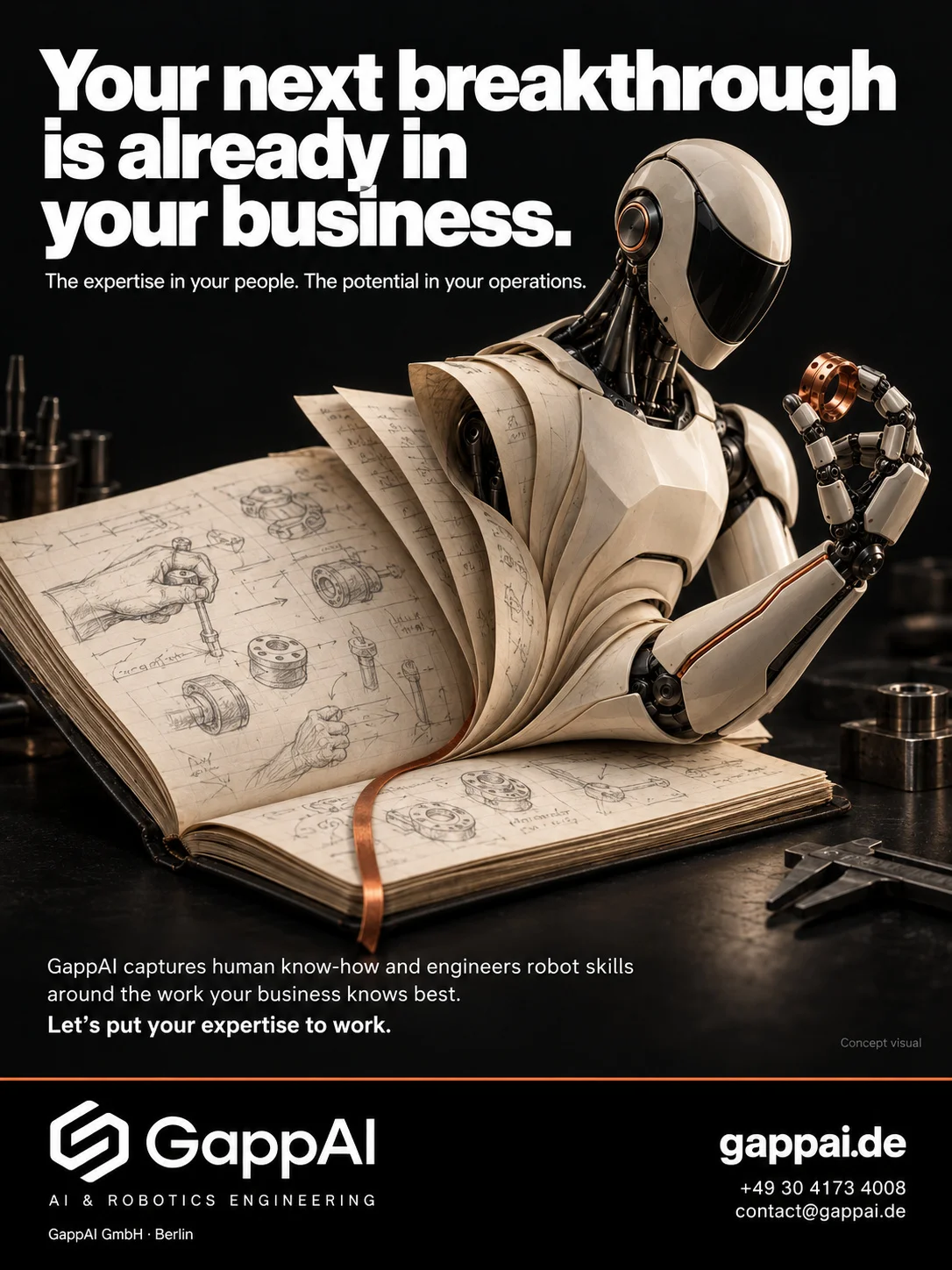
Your next breakthrough is already in your business.
The judgement, sequences and practical knowledge of experienced people are a starting point for robot learning. Let’s identify the expertise worth capturing—and the task worth engineering.
AI-generated concept illustration · Not a customer deployment
AI & Robotics EngineeringGappAI GmbH · Berlin
07 / Commercial model
Develop a new skill. Or license and adapt a validated one.
Customers do not buy an unsupported generic capability. Each commercial use is tied to a documented skill version, robot configuration, environment, safety envelope and validation status.
Path 01
New skill development
A paid pilot combines operation analysis, demonstrations, data, engineering and controlled validation to create the first evidence-bound capability.
Path 02
Library skill licence
A compatible skill is licensed, adapted to the robot, calibrated to the environment and revalidated for the customer's conditions before deployment.
Path 03
Versioned operation
Monitoring, approved operational feedback, recovery evidence and controlled releases support the skill after deployment and create the path to wider reuse.
Skill licenceRobot adaptationEnvironment calibrationDeployment & integrationVersioned updatesRecovery, support & monitoring
Physical AI Pilot / Skill development
Bring us the operation that should become reusable.
Request a Pilot Proposal ↗︎Availability, validation status and supported configurations are assessed for each inquiry. No illustrative skill on this page is offered as deployment-ready unless expressly confirmed in writing by GappAI.