
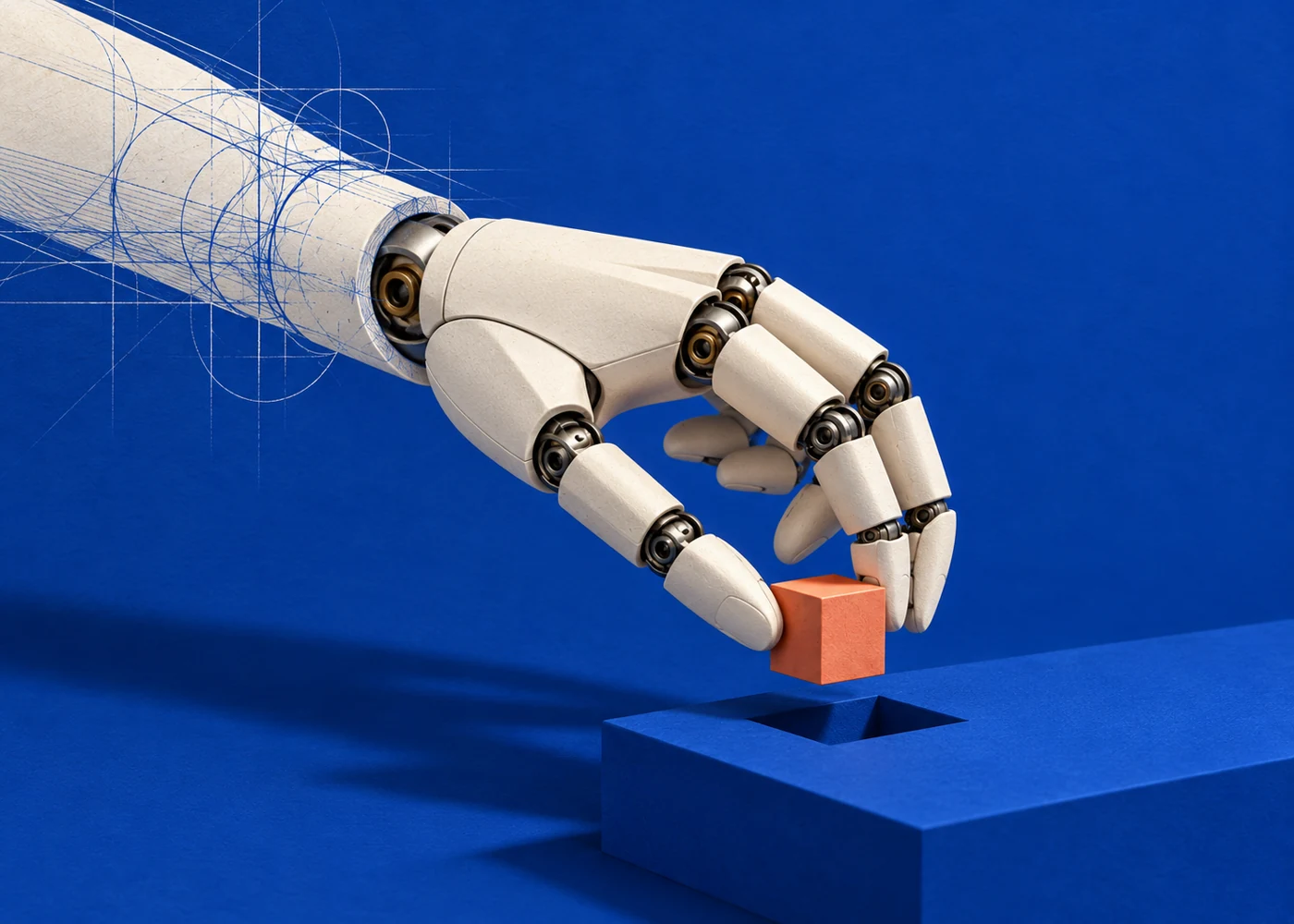
A robot lifts a glass from a table and places it on a tray. The movement is fluid; the demonstration is impressive. Now change the scene. Make the glass wet. Move the tray a few centimetres. Let someone walk past the table. Then ask a more demanding question: by the end of the day, has this job actually become easier?
This small thought experiment exposes a central question in robotics. There is considerable distance between completing a movement and taking responsibility for a task within defined boundaries. Perception, control, software connections, maintenance and human experience all help close that distance.
This is where the first issue of GappAI Review looks when it ventures beyond the screen. Physical AI, intelligence that perceives and acts in the physical world, opens possibilities from factories to hotels. To understand their value, we must examine what a robot can do alongside what the work actually requires.
Begin by defining the work
An organisation's wish to acquire robots can start a conversation. A better starting question is specific: which task, under what conditions, will reduce whose burden? Moving materials between two points sounds straightforward. Preparing the material, loading it at the right time, keeping the route available and confirming delivery are also parts of that job.
Before selecting a robot, define where the task begins and ends. Moving a box and delivering the correct box, undamaged and on time, to the station that needs it are different definitions of success. The second connects motion to an operational result. The same reasoning applies to hospital logistics or hotel linen flows, with the conditions of each setting assessed separately.
The people who do the work every day hold essential knowledge. They know which door sticks, when demand intensifies and which packaging tears easily. Reading a workflow only through management dashboards can leave out details that will matter greatly to automation.
Measure with a common yardstick
The US National Institute of Standards and Technology provides a practical illustration through its robotic assembly task boards. Defined activities include inserting parts, making connections, and routing belts and cables. Shared test arrangements help compare systems under more consistent conditions. They are not proof that a robot can complete an entire shift in any business. [1]
In an operational setting, this approach becomes an evaluation process that reaches beyond a single demonstration. How many attempts are needed? Does the result pass quality control? How often does a person intervene? How quickly does work resume? Must nearby employees stop their own tasks to let the robot continue?
Two systems can finish the same task in similar times while placing very different demands on their surroundings. If one needs frequent repositioning, employees' time becomes an invisible input. Robot runtime alone is therefore an incomplete measure. Preparation, waiting, intervention and rework belong in the calculation too.
A valuable skill: making limits clear
Uncertainty is ordinary in the physical world. An object may be missing; a corridor may be temporarily blocked. How a system behaves then matters as much as its performance when everything goes well. Reporting a problem clearly, stopping when appropriate and handing responsibility to an authorised person are behaviours that must be designed into the operation.
A delivery robot failing to reach its destination need not mean that the whole process has failed. If it alerts the right person, keeps the material traceable and avoids obstructing other work, the exception may be manageable. A delivery marked complete on a screen but never received, by contrast, can mislead every decision that follows.
Autonomy is a matter of degree. Completing certain tasks independently does not establish independence in every situation. Procurement and pilot discussions should make clear which steps are automatic, remotely supported or dependent on someone being present.
The calendar matters as much as the calculator
Economic assessment extends beyond a device's price tag. Installation, changes to a building or production line, software connections, training, maintenance and fallback operations belong in the same account. Frequency matters as well. A task needed briefly each day has a different investment logic from a continuously repeated flow.
Turning saved time into business value requires a plan. Removing short waits scattered through a shift does not automatically create a usable hour. Time has practical value when it relieves a bottleneck, reduces late deliveries or creates room for more careful quality checks. Such benefits should be observed in a pilot, not presented as achievements at its outset.
A good pilot records the current operation first. Comparisons should involve the same task, similar demand and the same quality expectations. Success and stopping criteria agreed in advance make the final decision more honest. The right outcome may be wider deployment, a redesigned workflow or a different technical approach.
What changes in a person's day?
The European Agency for Safety and Health at Work, EU-OSHA, describes opportunities for advanced robotics to remove people from heavy or hazardous tasks, alongside challenges involving interaction, overreliance and work organisation. The technology's effect on employees must be considered together with how it is used. [2]
We therefore propose including employee experience in any assessment of usefulness. Is the physical load lighter? Are responsibilities clear? Does an employee know what to do when a system fails? Can a customer or guest reach a person when needed? These questions shape the service itself.
Some effective robots of the future may attract less attention. Materials arrive when needed. A workflow is interrupted less often. An employee can turn back to a customer during a busy moment. These are ways robotics could touch everyday life. They depend on thoughtful work organisation as well as technical capability.
Return to the glass on the table. Lifting it is an engineering achievement. Turning that movement into a dependable daily service requires a wider collaboration. What makes a robot useful is how much that collaboration improves what people can accomplish.
Sources & further reading
A publication of GappAI GmbH. Analysis, publisher perspectives and conceptual AI illustrations are identified as such.
Editorial team & standards · Report an errorContinue the conversation with GappAI.
Discuss your operation ↗