
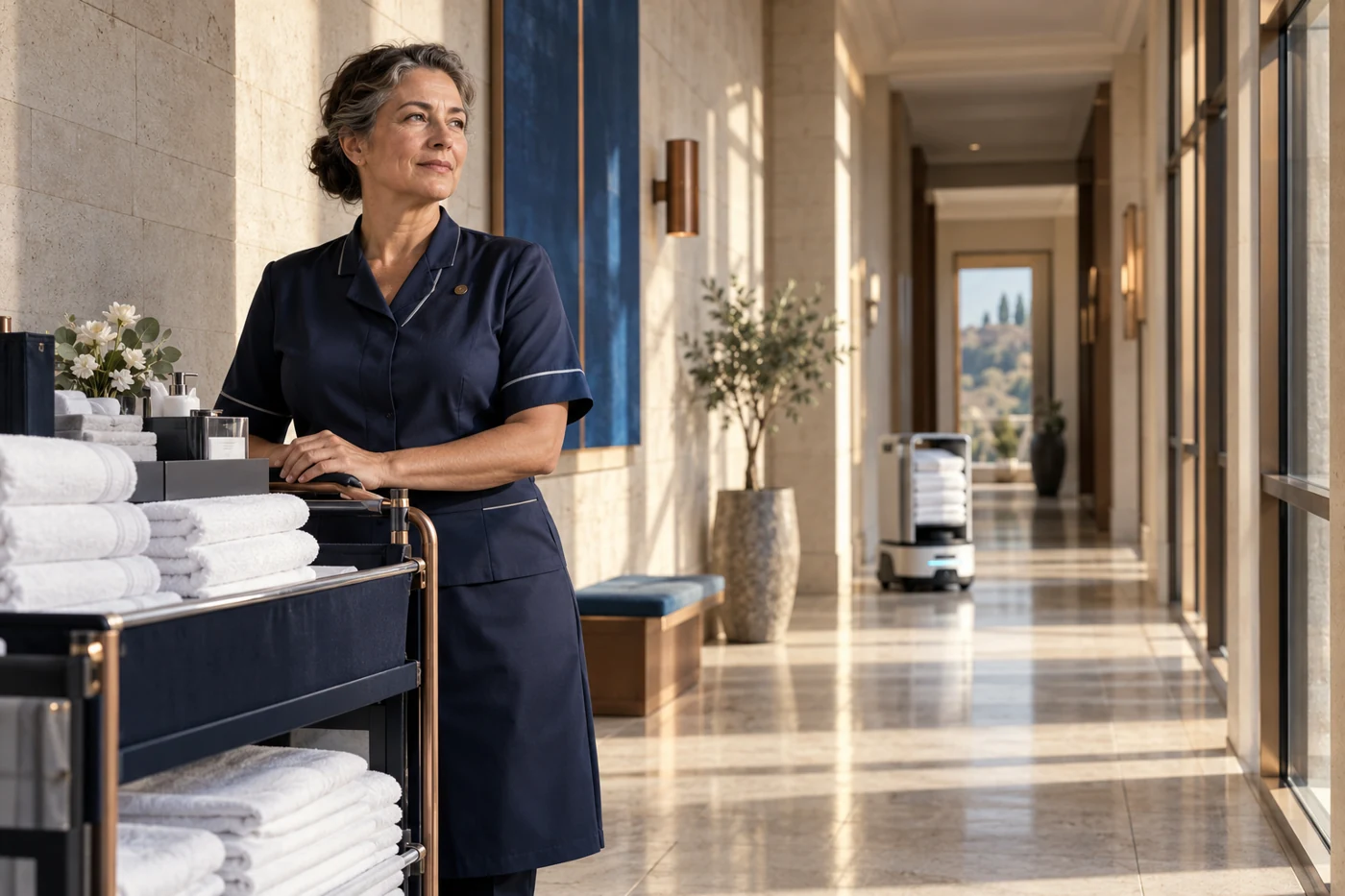
The hotel day below is an illustrative scenario, not an interview with a real employee or a report of a field observation. Research and historical examples are identified separately.
Early morning. A housekeeping trolley is being prepared with clean sheets, towels and cleaning supplies. The day's departures are known, and early arrivals are expected. One room needs preparing; a guest in another would like to sleep a little longer. A decision about priorities is needed before the working day has properly begun.
Could a robot do this job? The scene contains several questions. Moving the trolley, placing a towel, assessing a room and responding appropriately to a guest belong to one profession. Their technical requirements and human significance differ.
The US Department of Labor-sponsored O*NET occupational database lists tasks including moving supplies, cleaning rooms, replenishing stock, reporting found belongings and requesting repairs. We use this American classification to illustrate the variety inside a job title, not to measure employment in Germany. [1]
Morning: the time spent in corridors
In our example, the first need is to get clean supplies to the correct floor. Repeated transport between defined points may be suitable for robotic support. Yet transport itself has several stages. Who prepares the supplies? Who loads them? How is the lift accessed? What happens if the recipient is in the middle of another task?
These answers matter as much as the robot's travelling time. If an employee has to stop work to locate or recover the system at every delivery, time saved in transport may disappear elsewhere. A useful implementation considers the whole flow, from preparation to confirmation of receipt.
Robot deliveries in hotels are not a new idea. In a 2018 company publication, Millennium Hotels & Resorts described AURA delivering water, towels and toiletries at M Social in Singapore. This dated account illustrates a particular service task assigned to a robot. It does not independently establish staffing effects, current use or net productivity gains. [2]
Before lunch: a hundred small differences
Enter our example room. A chair is out of place. A bedspread has fallen to the floor. A guest's possession lies on the bedside table. A maintenance problem is visible in the bathroom. Preparing the room involves noticing these differences as well as performing movements in sequence.
For robotics, tasks are not equally difficult. Planned cleaning on an open floor and handling a sheet whose shape changes with every touch are different problems. Recognising an object through a camera does not by itself determine the force needed to grasp it or where to put it. Handling a guest's belongings also requires explicit hotel rules.
The statement that a robot can clean a room therefore needs qualification. Which surfaces? What preparation? How much human support? Who verifies the quality? Automating one part does not establish that the whole room is ready for a guest. Final inspection and unexpected situations require their own arrangements.
Here, experience becomes visible. A skill acquired over years may not be expressed in a lengthy explanation: noticing a mark, remembering a missing item or passing the right information to maintenance. Making that knowledge explicit with employees can improve both automation preparation and training.
Afternoon: when service changes direction
In our scenario, a guest asks for help in the corridor. A flight has been delayed and they need a later checkout. Resolving the request connects room availability, a reception decision and the cleaning schedule. Another guest does not want to use a device and simply wishes to explain a problem to a member of staff.
How a future hotel handles such encounters is a service decision. Robot delivery and digital communication may be available, while a clear route to a person remains essential. Technology choices should account for guests of different ages and with different needs.
The employee's role may change too. Starting a task, reading system status, reporting an exception and explaining a process to guests can become new responsibilities. Introducing robots without allowing time for training risks adding another, less visible job to the existing one.
The real account at the end of a shift
EU-OSHA's work calls for examining psychosocial and organisational effects alongside opportunities to improve physical workloads. Less carrying or fewer repetitive movements may help; the new way of working may also create different pressures. [3]
In our example hotel, asking whether staff like a device would be insufficient. How often did they interrupt their work? How did physical strain change? Was support available when problems arose? Did saved time allow more attentive service, or were more tasks fitted into the same shift? These are concrete questions for a pilot evaluation.
Employment has no single guaranteed outcome either. Automating a task does not by itself show that a position will disappear. Work volume, service standards, hours and organisational decisions affect the result. Nor does claiming that every robot creates better jobs answer employees' reasonable questions.
Employees and their representatives, where present, should be involved before the implementation is complete. Which tasks will transfer, how new responsibilities will be recognised, and how training will work belong in the initial plan.
Reframing the question together
Look closely at one hotel employee's day and the future becomes more concrete. Certain tasks may be assigned to robots, other capabilities are still being developed, and people continue to make decisions. The boundaries depend on the system and its working environment.
Could a robot do my job should open the conversation. A further question for staff and management follows: which part of this work could technology take on so that we can do the rest of the day better?
At the end of the shift, the answer will be found in the employee's experience: how tired they feel going home, the attention they could give a guest, and how well they understand tomorrow's work.
Sources & further reading
A publication of GappAI GmbH. Analysis, publisher perspectives and conceptual AI illustrations are identified as such.
Editorial team & standards · Report an errorContinue the conversation with GappAI.
Discuss your operation ↗